If those who have studied the art of writing are in accord on any one point, it is this: the surest way to arouse and hold the reader’s attention is by being specific, definite, and concrete. The greatest writers–Homer, Dante, Shakespeare–are effective largely because they deal in particulars and report the details that matter. Their words call up pictures.
–Strunk & White, The Elements of Style
Lady Bricabrac and Professor Vintage are always thinking about words. (And if not “always,” since it’s important to know from the outset in case you haven’t met him yet that Mr. Ramsay is vehemently opposed—in all things—to unqualified statements of fact, as well as adverbs and superlatives, then “usually.”) And, as we all well know, words sell…well, everything.

Dealing in Particulars and Reporting Details that Matter: Making Stuff Vintage
Vintage dealers need words perhaps more than most other tribes of merchants. And this might explain, in part, their tendency to get creative (Lady B might even go so far as “fast and loose”) with language. It’s no accident that the price tags at most antique malls or vintage shops are large enough to accommodate more than the mere price. Those sellers know what they’re doing. I can’t begin to fathom how much I know because of those tags. In fact—and again, this is no accident when a seller knows what he’s doing—I am often as intrigued by the tags I find on old things for sale as I am in the objects themselves. When you pass by the price tags at an antique mall or junk shop, you are likely missing out on a tweet-sized history lesson.
Not only do the words on a tag tell you something about the object and its role in the kitchens, tool sheds, or powder rooms of the past, but they also convey something about the seller and how much she knows about the object and its previous life. Lady B is, as you might expect, unparalleled in scenting out amateurism (and, begging Mr. Ramsay’s pardon, her skill is universally applicable and cannot be qualified) and would advise you to use a vague or—better still—downright incorrect product description to your bartering advantage. After all, why pay full price for ignorance and laziness?
A good dealer will do her homework because naming an object is powerful. Classifying, categorizing, and identifying something—anything—lends it that necessary context, a sense of belonging, a definite importance. In short, dignity. A well-crafted tag can be irresistible. It is a niche art form. It often makes all the difference between what one does not need (stuff) and what one cannot do without (something).
Here is an illustration of the difference words can make in the vintage economy. Early this past summer, I was trawling around a newly opened self-styled “picker’s paradise” out in the country in the upstate of South Carolina. The place is–was–a defunct warehouse; the “displays” consist of whatever items are sitting near two open bays (the kind where tractor trailers load and unload). I’m not—well, I wasn’t—a glass collector. But a group of pink and green drinking glasses caught my eye in one of the first booths. Each of the eight glasses depicted a big mansion on one side and a strolling girl—with hoop skirt and parasol—on the opposite. The rest of each glass was decorated in little white and pink flowers with loopy petals, all the way around. They were kind of cute and kind of strange (a winning combination and my own variation on Lady B’s “hideous sublime”). The tag read, “Southern Bell [sic] Tea Glasses $24.” Kind of cute and kind of strange, but not worth $24. But “tea glasses.” Hm.

Atmosphere
Later in the summer, I was trawling around a (theoretically) finer antique shop closer to home with Lady B when I discovered a similar group of glasses. The colors were different—bright yellow with red details—but the theme was the same. Southern: mansion, belle. These glasses were marked “Vintage Sweet Tea Glasses $74.” There were four glasses. If the theme (these, again?) didn’t pique my interest, then the price surely did.

Vintage Libbey Sweet Tea Glass, circa 1940
If they’re smart, Ebay and Etsy vintage sellers provide as much information as they can find to describe and contextualize their merchandise. Buyers have no immediate, tangible connection to their items, after all, and there is not much chance of an emotional or impulse buy. Online dealers rely on photos of course, but what they really use are words. Calling a set of interesting drinking glasses “vintage” is a start, but it’s generic, flexible, and sometimes specious. Calling the same set “sweet tea glasses” gets us a little further; now we’re discovering there’s a genre of iced tea glasses out there. (Similar sets are also called julep glasses and lemonade glasses.) The “Southern Belle” spells out what I can already see, but put with the other information suggests the even more specific genre of Southern iced tea glasses. By the time I’m done poking around online vintage marketplaces (and confirming some dates on company web sites), I’ve learned that Libbey made multiple sets of Plantation Scenes glasses—marketed at midcentury Southern hostesses—that sought to capitalize on the popularity of Gone With the Wind (Margaret Mitchell’s novel came out in 1936—and won the Pulitzer; the film was released in 1939).
This information—context, classification—makes a difference. It’s provenance, yes, but that provenance is built by words. Just a few words makes the same object more valuable. There’s something different about “Vintage (signed) Libbey Plantation Scenes Sweet Tea Hostess Set” and “Pretty Pink and Green Glasses–Old!!” or “Vintage Glasses” or even “Vintage Southern Bell [sic] Tea Glasses.”
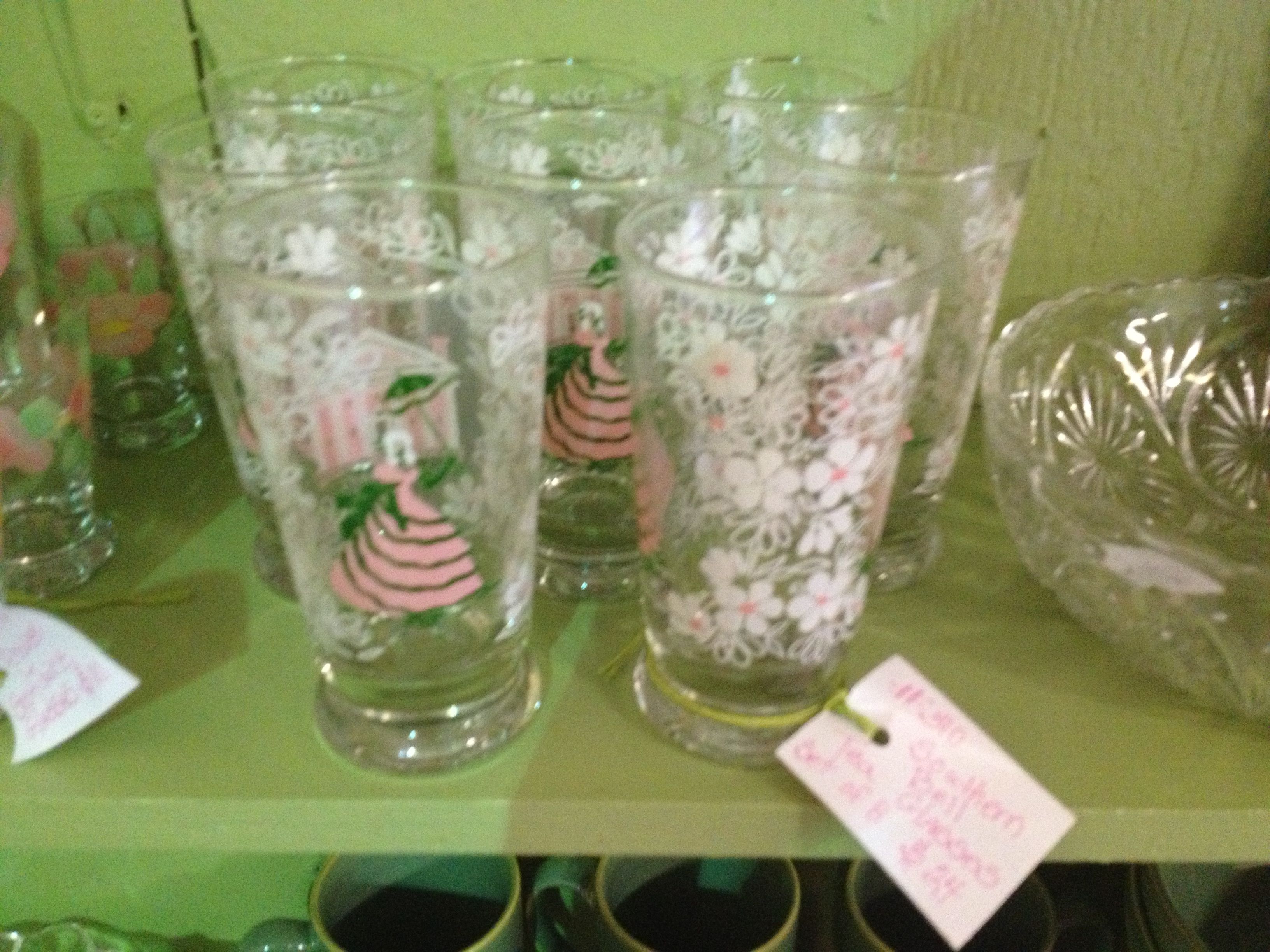
Kind of Cute and Kind of Strange: Libbey Southern Belle Tea Glasses
Over Labor Day, when I found myself back in the Upstate countryside, I bought the pink and green set. They were exactly the same as when I didn’t buy them the first time, but once I could put a name to them, once I knew what they were, they became something… more than they had been.
“You from around here?” the man at the register asked when I tried to negotiate the $24. But that’s altogether another story.


 The Old Curiosity Blog
I just bought the same pink and green set at Vintage Garage in Chicago for $20 🙂 I thought they were sweet.